TLS inspection: When encrypted traffic goes through security screening
Encryption protects data as it travels across the internet, but it can also conceal threats. TLS inspection acts as a security checkpoint for encrypted traffic, allowing organizations to detect malicious content before it gets through.


Would you feel safe if no bags were X-rayed at the airport? I'm not sure I would! But would it be fair to say that airport security is the airport's own implementation of Zero Trust?
Since the early 1970s, airport baggage screening and inspection have become increasingly extensive and thorough. These measures expanded significantly after the September 11 attacks.
Since then, screening both checked and carry-on baggage has become standard procedure. Illegal or potentially dangerous items are removed and kept off the flight. If you arrived at an airport today and were told that no bags would be X-rayed, would you feel comfortable with that?
When encryption hides threats
Most network traffic today uses encrypted protocols to conceal what is being transmitted, much like a suitcase hides its contents. In itself, this is a security measure designed to keep information from falling into the wrong hands. But what happens when attackers use this protection to avoid detection?
An attacker may have a valid passport and be traveling to a legitimate destination, but if we cannot inspect their suitcase, we risk allowing something dangerous or illegal on board. The organization's "X-ray machine" is therefore the checkpoint where TLS inspection takes place.

The security checkpoint for encrypted traffic
Modern next-generation firewalls (NGFWs), Secure Firewalls (SFWs), Secure Access Service Edge (SASE), and Security Service Edge (SSE) solutions provide precisely this kind of security screening for traffic passing through them.
It is essential to implement and configure this within your organization to validate traffic transmitted over encrypted protocols.
Just think about it: How often do you browse the internet and see an "Insecure website" warning? Not often, I'd imagine. That means you're using an encrypted protocol to transmit traffic or load a website. Your organization therefore needs TLS inspection to protect users from malicious actors hiding behind that encryption.
How TLS inspection works in practice
When TLS inspection is implemented in an organization, a checkpoint, traditionally a firewall, behaves much like an attacker carrying out a man-in-the-middle (MITM) attack. The difference is that this is done to protect users from malicious actors, but the underlying concept is the same.
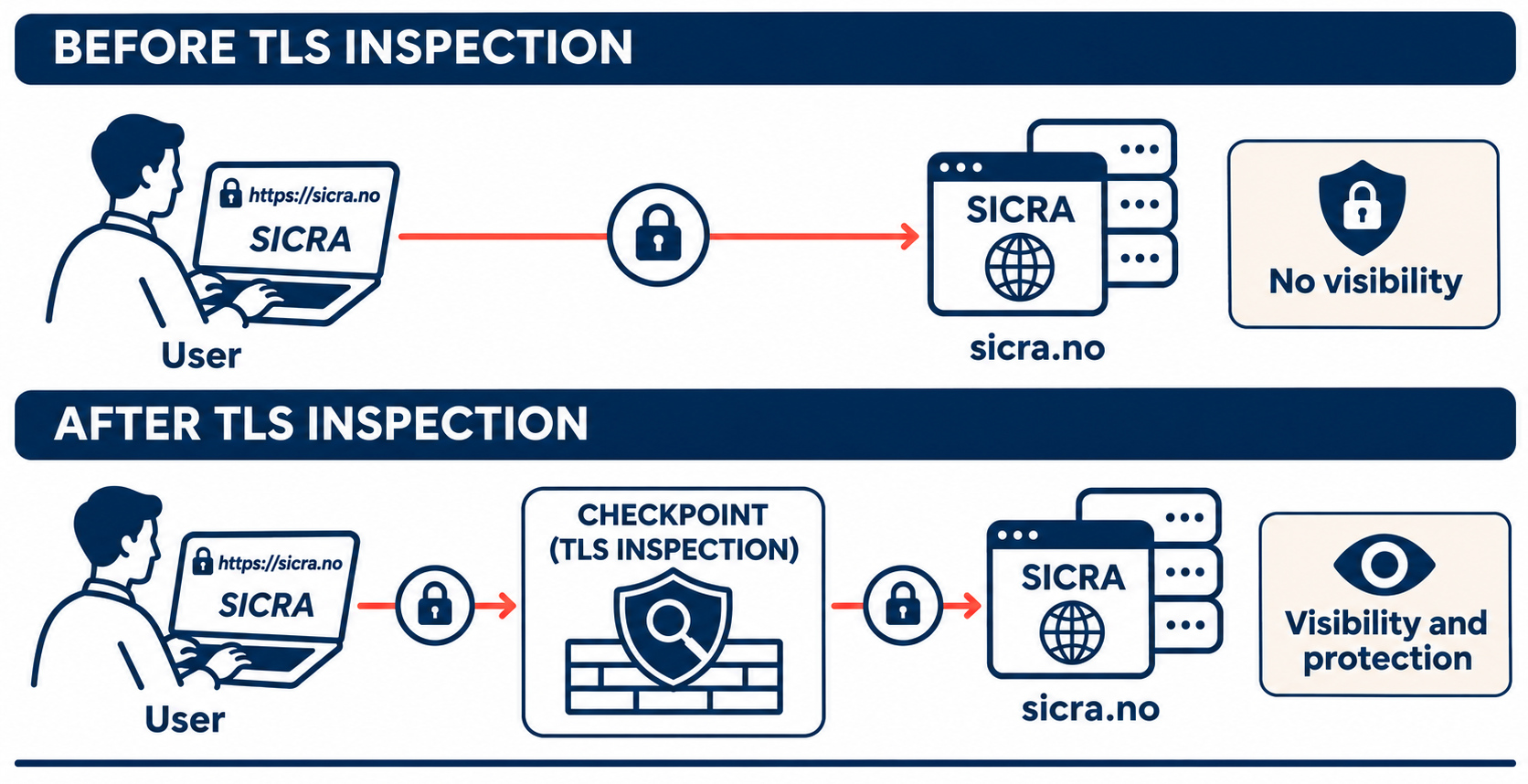
The encrypted connection originally established directly between the user and a website is no longer a single connection. Instead, two encrypted connections are established: one between the user and the checkpoint, and another between the checkpoint and the website being accessed. This preserves encryption as data travels across untrusted networks while providing the visibility needed to detect malicious actors.
A visit to Sicra.no as an example
Let's look at an example. Imagine one of your users wants to visit Sicra.no in their browser. When the user opens Sicra.no, their computer sends a request to the service hosting the website, asking to establish a secure connection using HTTPS.
Sicra.no then responds with its public certificate, signed by a trusted third party. Through this trust relationship, the computer and Sicra.no establish an encrypted connection that no one else can read, using the internet's Public Key Infrastructure (PKI).
The checkpoint establishes the connections
Once TLS inspection has been implemented, the request sent to Sicra.no is intercepted by the organization's checkpoint. The checkpoint, which may be a firewall, responds to the computer with its own certificate. If the computer trusts the checkpoint's certificate, an encrypted connection is established between them.
The checkpoint then sends the same request to Sicra.no and establishes a new encrypted connection. The checkpoint now has visibility into the data being transmitted and can protect the user.
An important part of Zero Trust
This is an important part of an organization's Zero Trust implementation. Without the ability to inspect encrypted traffic between users and the internet, it becomes difficult to protect users in accordance with the Zero Trust principle of "never trust, always verify."
Explore more

SASE: From chaos to control in your own house

How the food industry can protect itself against cyberattacks

Reintroducing Zero Trust in the age of AI