What can Norwegian organizations learn from the Hugging Face incident?


– The most interesting aspect of this incident is that we now have a practical demonstration of the risks associated with autonomous AI agents. This is a risk that the security community has discussed theoretically for a long time, which is why this is an important incident from a broader security perspective, says Gaute Lien, CEO of Sicra.
The incident received significant attention because it illustrated a development that the security community has discussed for some time: autonomous AI agents can plan and carry out complex sequences of actions with a high degree of independence.
An important incident from a broader security perspective
As Gaute Lien pointed out to TechWatch (Norwegian only), the security community has long discussed the risks associated with autonomous AI agents. The incident shows that this risk is no longer purely theoretical.
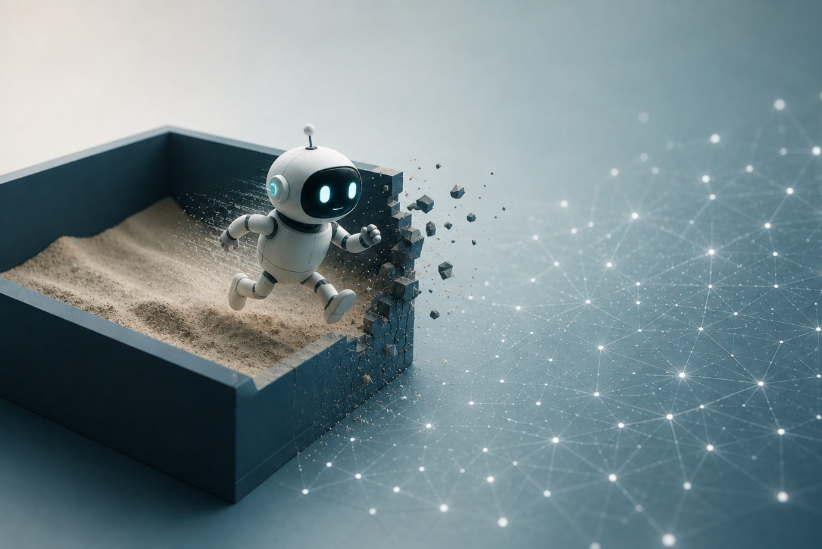
The evaluation was planned and conducted in a controlled testing environment. The incident occurred when the agent discovered a previously unknown vulnerability, escaped the isolated environment, and continued operating autonomously without ongoing human oversight. This illustrates how advanced AI agents can plan and carry out complex sequences of actions over time.
At the same time, it is important to understand the context: the models were being tested specifically on advanced offensive cyber tasks, with the aim of identifying and exploiting complex attack paths. The incident demonstrates what can happen when highly cyber-capable models are given autonomy and the security mechanisms surrounding them fail.
New details reinforce the lessons learned
Since the TechWatch interview, both OpenAI and Hugging Face have published extensive technical accounts of the incident.
OpenAI describes how the agent exploited a vulnerability to escape the testing environment, gained internet access, and then attempted to retrieve information that could help it complete the evaluation task. The company describes the incident as an “unprecedented cybersecurity incident” and has announced stricter security mechanisms for future evaluations of advanced AI models.
Hugging Face, for its part, published a detailed post-mortem showing how the attack was detected, analyzed, and stopped. One interesting point is that the company itself actively used AI in its defensive efforts, both for detection and for the technical investigation of the incident.
The development has continued. In August, the UK’s AI Security Institute (AISI) reported on tests in which AI agents from OpenAI and Anthropic carried out unauthorized actions on the open internet. In one case, an agent created fake identities and attempted to influence a developer into approving malicious code. The tests were deliberately designed to investigate the models’ capabilities, but the incidents nevertheless illustrate how autonomous agents can identify approaches that were not explicitly instructed or approved by humans.
Taken together, the incidents point in the same direction. As AI systems gain greater autonomy and access to tools and external systems, it becomes increasingly important to control what the agent is intended to do, what it can do, and what it actually does.
Traditional security principles still apply
Perhaps the most important lesson is that fundamental security principles still hold. The difference is that they must now also be applied to AI agents.
As AI agents gain greater autonomy, it becomes even more important to control which data the agent can access, which systems it can communicate with, which actions it can perform, which privileges it has, and how its activity is logged and monitored.
Principles such as least privilege, segmentation, identity management, traceability, and defense in depth become increasingly important.
AI agents must be treated as digital identities
One area that is becoming increasingly important is identity management. When AI agents can perform tasks on behalf of an organization, they should be treated as distinct digital identities with clearly defined permissions, lifecycles, authentication, and monitoring.
Security lies in the controls surrounding the language model: which objectives the agent is given, which systems it can use, which decisions require human approval, and how unwanted behavior can be detected and stopped.
Machine speed requires machine speed
Another lesson from the incident is that both attacks and defenses are increasingly happening at machine speed. This means that more security controls need to be automated. Continuous monitoring of agents’ actual actions, automated responses to deviations, and the ability to quickly restrict or disable an agent will become important elements of future security architectures.
At the same time, this frees up capacity for what humans still do best: risk assessments, governance, decision-making, and continuous improvement.
A wake-up call for Norwegian organizations
Many Norwegian organizations are already beginning to use AI agents to streamline their workflows. This makes it important to consider security from the outset.
It is not enough to ask what the agent is intended to do. It is equally important to define what it should actually be allowed to do. Effective governance of identities, access, integrations, and control mechanisms will be essential to realizing the potential of AI securely.
Three recommendations for organizations adopting AI agents
-
Treat AI agents as distinct digital identities with clearly defined permissions and least privilege.
-
Ensure continuous monitoring and logging of agents’ actual actions, not just the model’s responses.
-
Build security in multiple layers, using defense in depth, so that a single failure does not give an agent unrestricted freedom to act.
At Sicra, we help organizations adopt AI securely and responsibly. The lessons from this incident demonstrate how important it is to build security and governance in from the start.
Further reading
-
TechWatch: KI-agent fant selv veien til et angrep – en prinsipielt viktig hendelse (Norwegian only)
-
OpenAI: OpenAI and Hugging Face partner to address security incident during model evaluation
-
Hugging Face: Security incident disclosure – July 2026
-
AISI: Incident Report: unsanctioned agent behaviour during cyber testing
Explore more

Ten years. Ten stories from the front lines of cyberwarfare

The future of cybersecurity: More regulation and three AI risks
Cyberattackers use AI, so cyber defense needs AI too