Arctic Wolf 2026 Threat Report: Monitoring, identity, and access control become more important

For the fourth year in a row, the leading global security company Arctic Wolf has published its security report, Threat Report 2026. This year’s security report is based on millions of logs from attempted attacks around the world, combined with data from incidents that escalated into a full Incident Response (IR). The report summarizes the most common attack types and reveals the tactics, techniques, and procedures that cybercriminals use.
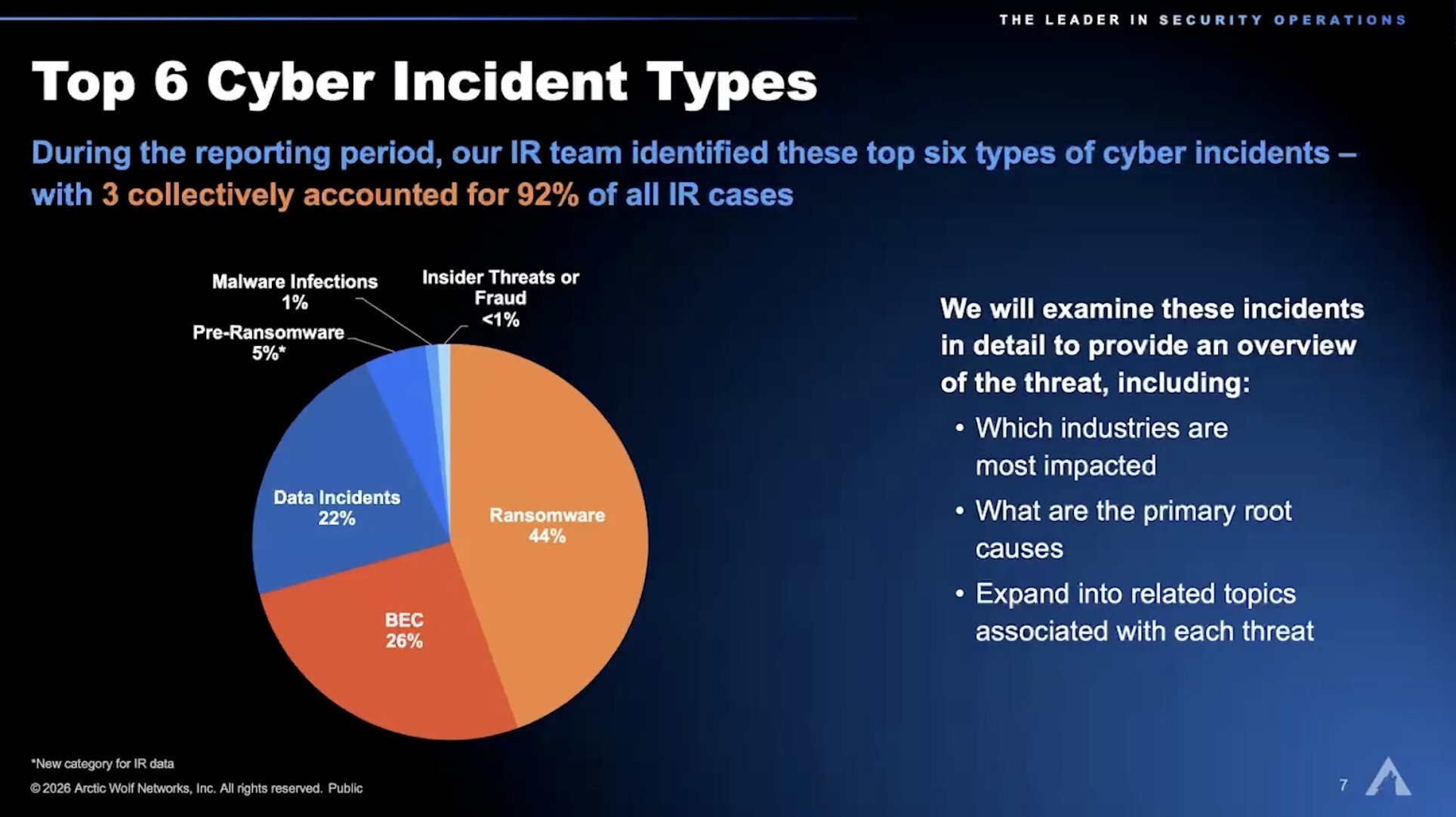
According to Threat Report 2026, three well-known threat types dominated cyberattacks in 2025
-
Ransomware: 44%
-
Business Email Compromise/email phishing: 26%
-
Data incidents/data breaches: 22%
Together, these three types accounted for 92 percent of all cyberattacks.
Ransomware – still the biggest
For the third year in a row, ransomware, in Norwegian often referred to as “løsepengevirus” (ransom virus), encryption virus, or crypto virus, is the largest and most serious category of cyberattacks. Nearly half of all cyberattacks are ransomware, where hackers lock down an organization’s files and demand payment (ransom) in exchange for sharing code that makes data, files, and information accessible again.
Even though the top ranking remains stable, the scale of attacks, the tactics, and the actors behind them have changed, Threat Report 2026 shows. Ransomware attacks increasingly are not just about “kidnapping files,” but about data theft, extortion, and reputational pressure. At the same time, the ecosystem around ransomware has become more mature, with separate groups distributing intrusion, monitoring, negotiation, and payment among themselves.
However, Threat Report 2026 points to a couple of bright spots:
-
Successful law enforcement operations: Coordinated law enforcement operations have reduced criminal groups such as LockBit, ALPHV/BlackCat, and BlackSuit, and only three groups (FOG, Akira, and PLAY) remained in the top 10 from last year.
-
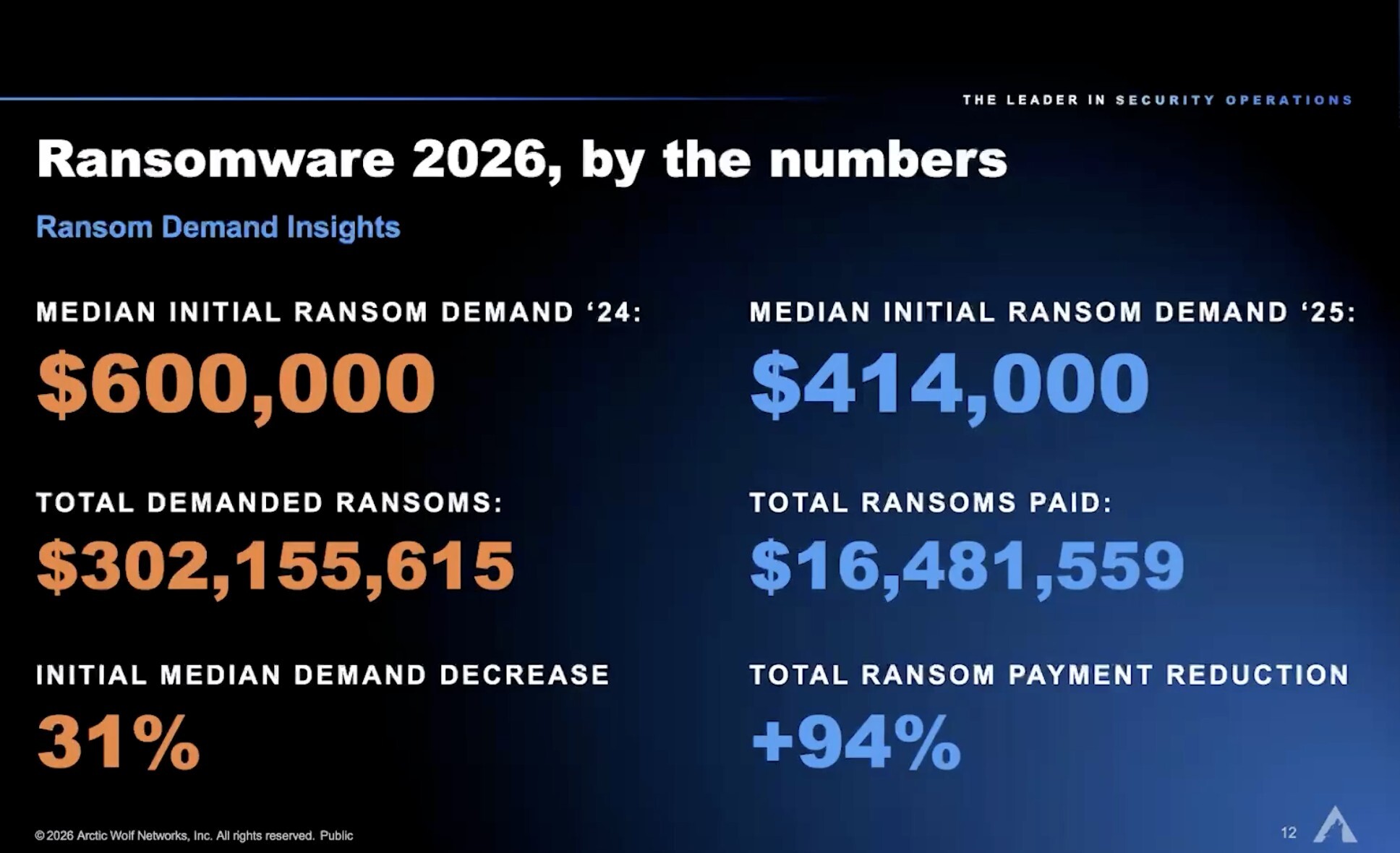
Reduced ransom demands: Among other things, better security and backup solutions contributed to ransoms dropping from an average of 5.7 million NOK per incident in 2024 to 4 million in 2025.
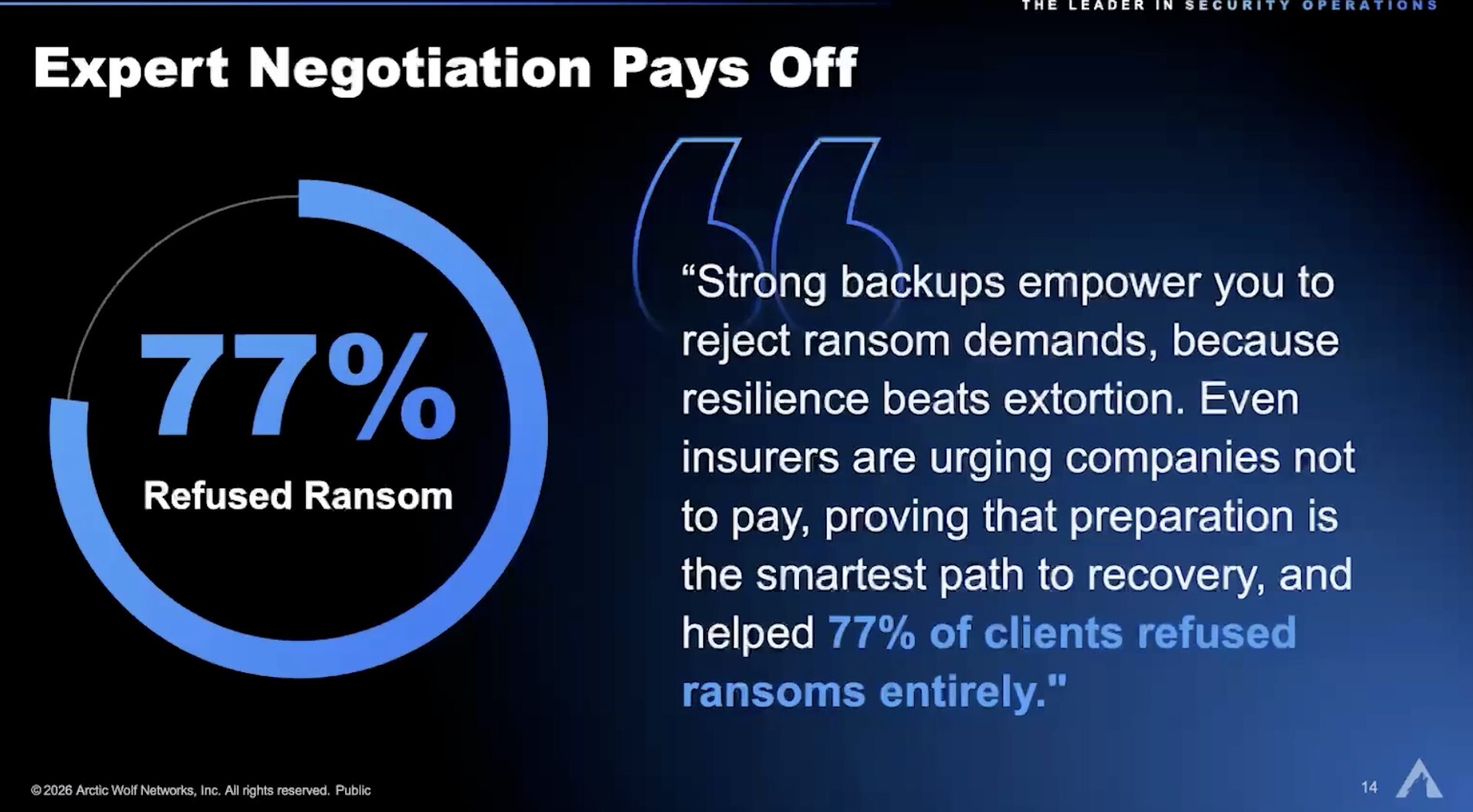
Arctic Wolf recommends contacting a professional intermediary from an IT security company if you are hit by ransomware. Then you can negotiate with the attackers and significantly reduce the ransom demand. In 77 percent of the cases Arctic Wolf is involved in, organizations avoid paying any ransom at all.
Threat Report 2026 also shows that ransomware attacks are increasingly combined with data theft and extortion. This is especially the case in attacks against European organizations, where cybercriminals use GDPR and government breach notification requirements as leverage.
Email still an open front door for criminals
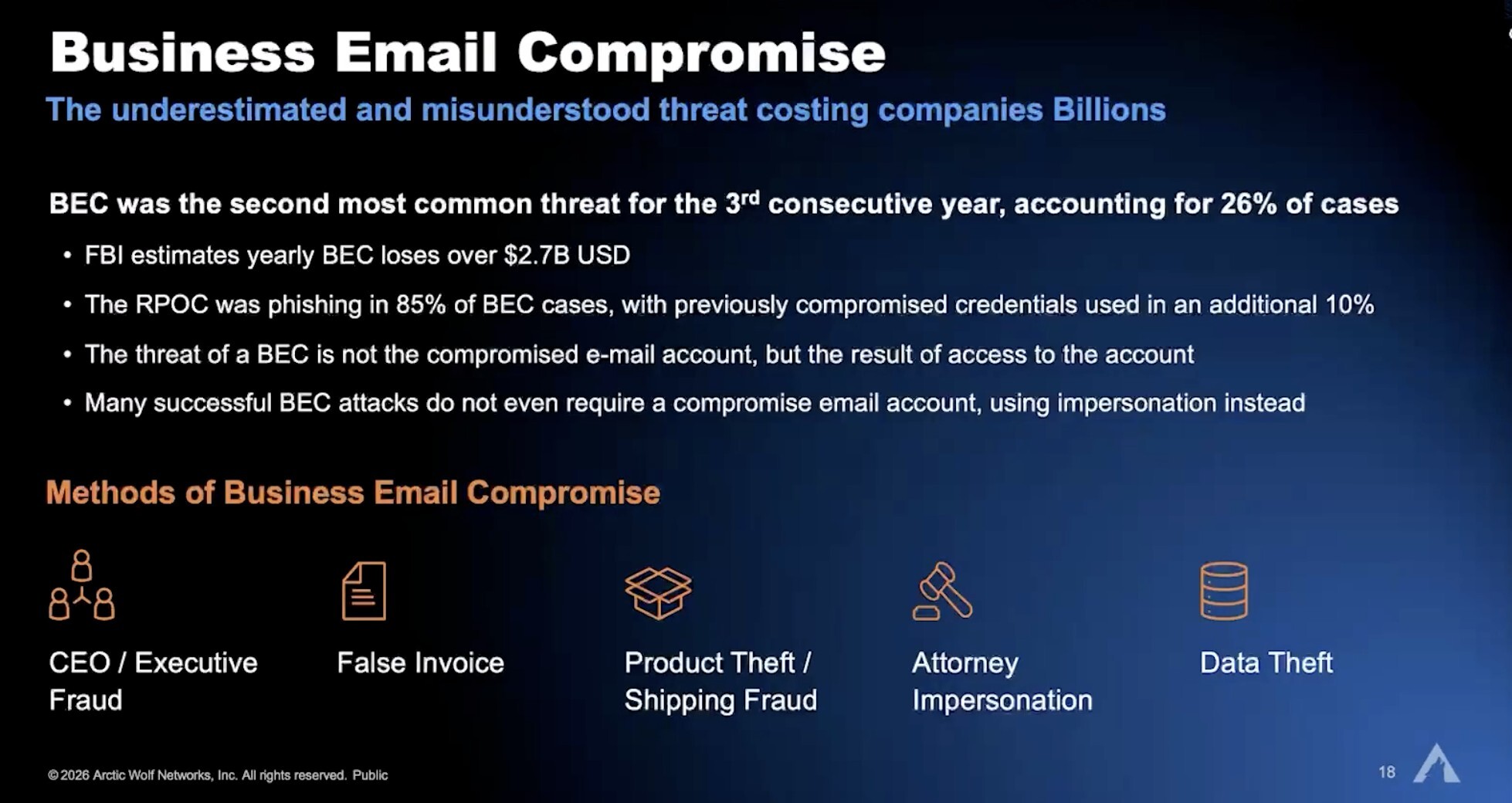
The Business Email Compromise (BEC) category, or attacks via email, accounts for a quarter of all cyberattacks, according to Threat Report 2026. Phishing—emails where attackers try to trick recipients into clicking links or attachments disguised as malware—makes up 85 percent of cases.
The most common methods cybercriminals use to trick recipients are:
-
CEO/executive fraud
-
fake invoices
-
vendor impersonation
-
direct money transfers
The American FBI estimates that BEC costs society more than 30 billion NOK globally each year.
Data breaches exploit remote access tools
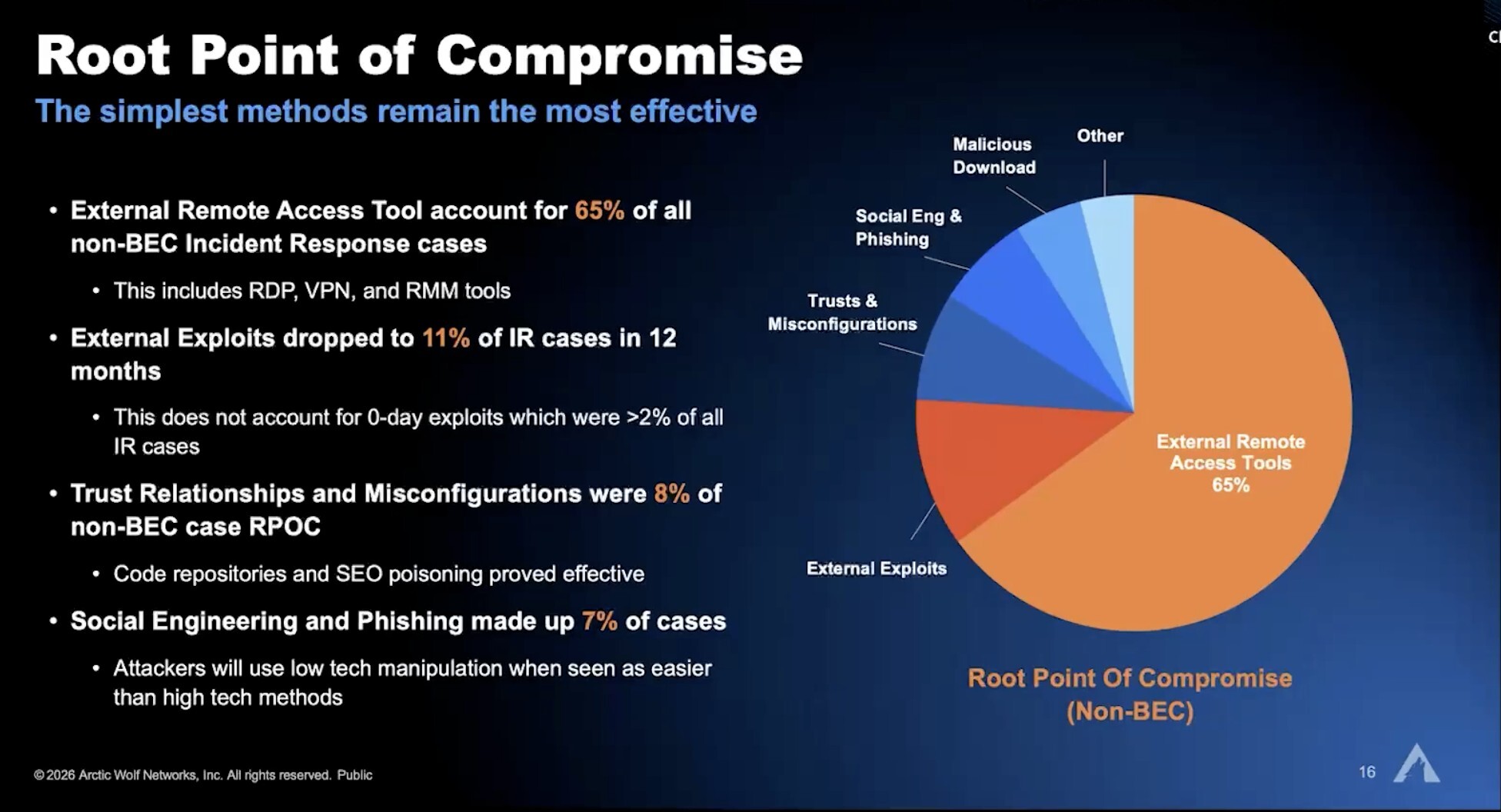
A lot of people focus on zero-day vulnerabilities, but Threat Report 2026 shows that most attacks happen through known weaknesses in common remote access tools such as Remote Desktop (RDP), VPN solutions, and Remote Monitoring and Management (RMM).
The different methods for data breaches are distributed as follows:
-
External remote access tools (RDP, VPN, RMM): 65%
-
External vulnerabilities: 11%
-
Misconfigurations and trust relationships: 8%
-
Social engineering and phishing: 7%
Instead of zero-day vulnerabilities, attackers use legitimate tools or stolen user accounts and maintain access in the IT environment with a low risk of being detected. The most effective solution is to have strong access control and strong monitoring solutions for IT infrastructure.
Predictions for 2026: AI and exploitation of global events
Threat Report 2026 concludes by pointing to likely trends in the current year. Arctic Wolf highlights two development tracks in particular: artificial intelligence (AI) and the exploitation of global events.
AI makes it easier to use social engineering to gain access to accounts, imitate voices, and create deepfake videos. AI also makes it easier to find and compile information and to imitate websites, products, and services.
Arctic Wolf warns in particular about two trends:
Information warfare:
Arctic Wolf expects a sharp increase in misinformation, disinformation, and malicious campaigns that attempt to influence politics and public opinion, create dissatisfaction, and drive divisions within population groups.
Exploitation of global events:
Criminals will exploit elections, sporting events, and other major events through social engineering, ticket scams, and delivery of malware via fake streaming services.
A bit further ahead, Arctic Wolf warns about what access to quantum computing could lead to. Many criminal organizations store encrypted data. They expect that within a few years, even more powerful computing tools will enable decryption that is not possible today.
What does this mean for Norwegian organizations?
Threat Report 2026 shows that:
-
The threat landscape is relatively stable, but the methods are evolving.
-
Identity and access are a main risk.
-
Data theft is just as serious as ransomware.
-
Security solutions, backups, and preparedness actually reduce the need to pay ransoms.
Sicra’s recommendation
Based on the findings in the report, Sicra recommends that organizations:
- Review all access and remote access solutions and identity controls.
- Test that backups and recovery (restore) actually work in practice.
- Involve leadership and the board in risk work
- Consider how regulations affect IT breaches and data loss
All organizations face the challenges the report describes. Sicra helps leaders understand, manage, and reduce digital risk—structured, business-oriented, and in line with regulatory requirements.
Read also “The Cyber Threat Landscape 2026: Insights from Arctic Wolf’s Threat Report” >
Explore more

Ten years. Ten stories from the front lines of cyberwarfare

The future of cybersecurity: More regulation and three AI risks

Cyberattackers use AI, so cyber defense needs AI too