AI is making your cloud bill more unpredictable
AI is making cloud consumption more dynamic and costs harder to predict. As cloud resources and AI agents consume capacity on demand, clear ownership, continuous cost control, and insight into what actually creates value are becoming increasingly important.
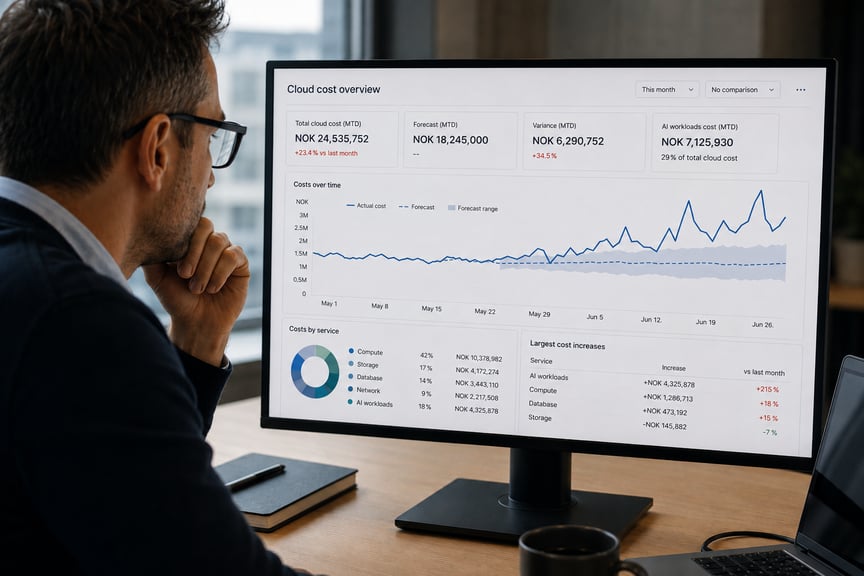

According to industry estimates, most organizations are paying 30 to 45 percent too much for their cloud services. On average, around a third of cloud spending is considered pure waste. Some have found that acceptable as long as cloud remained a predictable operating expense. As a former IT director at a company with significant cloud costs, I did not. AI is now making that bill both bigger and harder to predict.
Read “Azure Cost Optimization: The Complete Guide (2026)” from CloudZero >
You can budget for a high cost. You cannot budget as easily for a cost that fluctuates depending on how much an AI agent decides to work this month. A cost that is both growing and moving is as much the CFO’s concern as the CIO’s.
Where the money disappears
The most common mistake is paying for capacity no one uses. Stopped servers that still incur charges for storage and IP addresses. Test and development environments that run around the clock, even when no one is working. Simply shutting down what is not being used at night and on weekends can cut the cost of those environments by more than half.
Then there are the costs that remain invisible until they become expensive. Backups and data stay on costly storage long after they are needed because no one has established rules for when they should be moved or deleted. I once cleaned up an excessive amount of backup data at a large enterprise. With one decision, the company reduced its backup costs by approximately NOK 500,000 per month.
The commercial side is often the biggest lever of all. If you already have Windows or SQL licenses, Azure Hybrid Benefit allows you to reuse them in the cloud, and costs can fall by as much as 80 percent without changing a single line of code.
AI makes getting this wrong even more expensive. A powerful AI machine sitting idle and waiting can cost many times more than a standard server. Forget to shut it down when the job is done, and you are paying for nothing but idle capacity.
AI is running the meter
The biggest change is that AI is moving from fixed pricing to usage based pricing. GitHub Copilot moved to token based pricing in 2026. Heavy users, particularly those who let AI agents work autonomously, have reported bills many times higher than before.
An agent that calls itself and carries more and more text with it at every step can burn through tokens at a rate no one has budgeted for. Without a cap for each agent and visibility into consumption, you may not see the problem until the invoice arrives.
At the same time, the price per token has fallen dramatically in recent years. Yet the bill keeps growing because usage is increasing faster than prices are falling.
Read “LLM inference prices have fallen rapidly but unequally across tasks” from Epoch AI >
Anders Austlid Taskén, who runs a Norwegian AI company, argues in DN that today’s token prices are part of a capital strategy. The tech giants are keeping prices artificially low to lock in customers before capital markets start demanding returns. Today’s price is therefore a poor indicator of tomorrow’s.
Read “KI-regningen kommer. Hvem skal betale?” in DN >
Cheap now, expensive later
Services are sold cheaply to win customers, then prices go up once enough customers are locked in. When Broadcom acquired VMware, customers reported price increases of between 800 and 1,500 percent, affecting customers who could not simply switch providers. At Sicra, we have several customers who are now trying to move away from VMware.
Read “VMware price hikes? 800–1,500%, claim Euro customers” in The Register >
It is free to move data into the cloud, but expensive to move it out. Your negotiating power decreases accordingly. Lock in can quickly become expensive.
Someone has to own the number
There is an entire category of tools designed to give you visibility into cloud costs. They are useful, and you should have them. But do not confuse visibility with control. A tool can tell you where the money is going. It cannot tell you why, and it certainly cannot tell you who is going to fix it.
The cloud bill arrives in the finance department as a single number, with no one able to say which service or team it belongs to. At that point, it becomes impossible to challenge. A cost that no one owns is a cost that no one reduces.
KPIs can quickly become theater. If you measure only total cost, you punish growth. A growing company should spend more. What works is cost per outcome, combined with forecast accuracy. Two numbers reviewed every month beat ten numbers no one looks at.
This is not about saving money
It is a mistake to sell this as a cost cutting exercise. If a third of cloud spending is waste, that is money that has already been allocated and is being spent on nothing. Recover half of it, and you have funded next year’s AI initiative without asking for additional budget. That is a very different conversation to have with management than one about cutting costs.
If, on the other hand, you cut logging or redundancy just to save a little money, you may lose the ability to detect an attack or maintain high availability. An MIT study in 2025 found that 95 percent of enterprise AI pilots produced no measurable impact on the bottom line. That is why the goal should be cost per outcome.
Read “MIT report: 95% of generative AI pilots are failing” in Fortune >
Cloud costs and AI consumption will become some of the largest and most dynamic items in the cost base. They therefore belong in board reporting alongside other material cost drivers, with an owner, a forecast and an explanation when the variance becomes significant.
Where you should start
Start by giving the cost an owner, a named person who is accountable for the cloud bill and can explain variances, just as with other material cost items. At the same time, require the bill to be broken down. Without cost by team and service, there is no meaningful conversation to have, only a total.
Then track cost per unit rather than just the total, whether that means per customer, per transaction or per employee. That is where you can distinguish growth from waste. Put limits and visibility around AI consumption, with token budgets for each agent and user, and make consumption visible before the invoice arrives.
Preserve your exit options, and calculate what it would cost to move your data and switch providers before you commit. Decide what the money you free up will be used for. Otherwise, it will disappear back into operations without anyone noticing the benefit. And make cloud costs a permanent agenda item, with a short monthly review and a line in the board report whenever the amount is material.
We help organizations with parts of this, from FinOps practices to architecture that does not leak money. The ownership stays with you.
Those who build cost awareness into the way they use the cloud gain a real competitive advantage. Those who do not will discover that the cloud was never free, and that AI passed on the bill with interest.
Explore more

How to choose the right SOC services in 2026

Sicra SOC strengthens your organization’s cybersecurity

How Sicra SOC detects cyber threats